


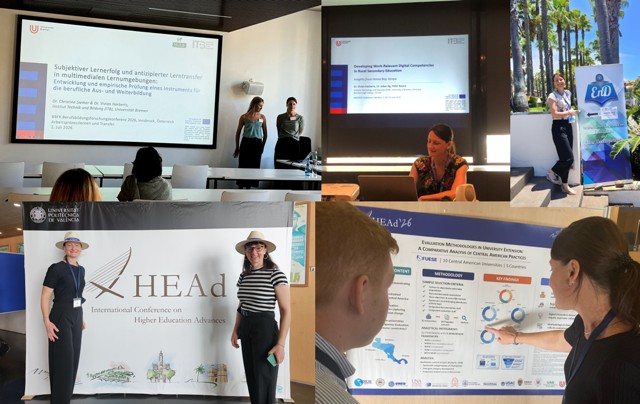
At HEAd'26 in Valencia (15–18 June), she presented, together with Myrthe Reinsberg, FUESE's comparative analysis of evaluation practices across 24 university continuing-education programs in Central America. Drawing on programs from Guatemala, El Salvador, Honduras, Costa Rica, and Panama, the paper introduced an eleven-field matrix to compare how universities evaluate their community-oriented work.
At END 2026 in Madeira (20–22 June), she presented two projects. MULE showed how VET programs in applied informatics can close the gap between industry-required digital skills and existing curricula, drawing on a cross-country comparison of occupational spheres of activity in Germany, Italy, Serbia, and Spain. DEVISE4KE reported on a strategy to support teachers' digital competencies, piloted in three rural secondary schools in Homa Bay County, Kenya, and benchmarked against the DigComp framework.
At BBFK in Innsbruck (3 July), MULE returned for a second round — this time with Dr. Christine Siemer, on how subjective learning success and anticipated learning transfer among pupils, students, and career changers can be measured in multimedia learning platforms. As a bonus, Dr. Harberts also presented interim results from the VETAssIst project, examining why VET teachers still hesitate to use AI in the classroom, along with the e-learning courses developed within the project.
Three conferences, three weeks, one hattrick — and a common thread running underneath: vocational education adapting its tools, its curricula, and its evaluation practices to a fast-changing world of work.